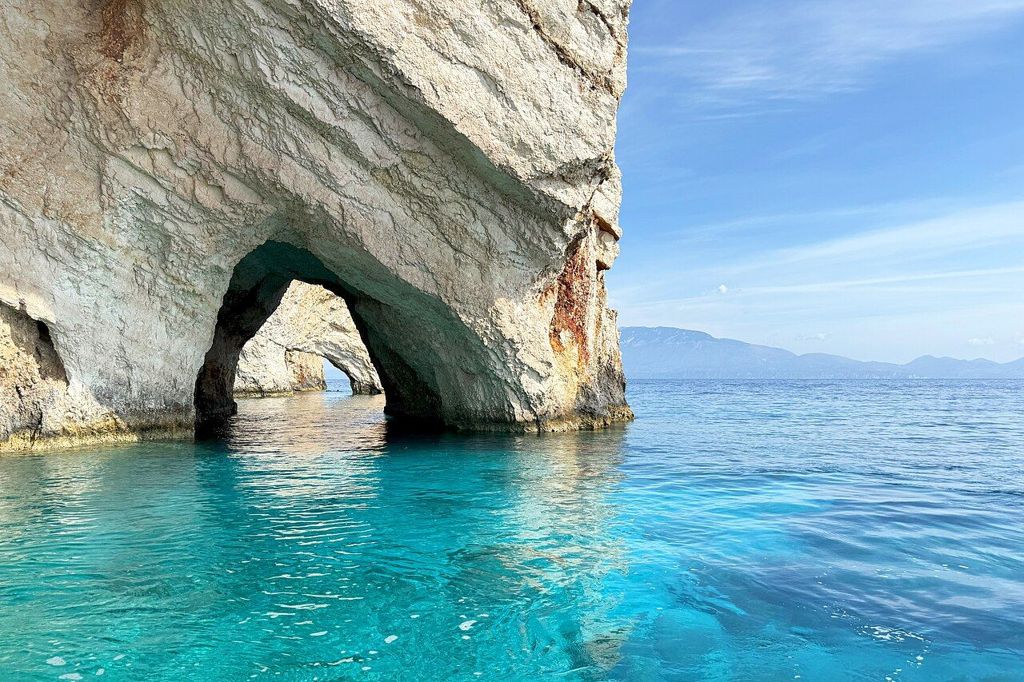
The Blue Caves at Cape Skinari
At the northern tip of Zakynthos, the sea has cut arches and caves into pale limestone. On a calm morning the water inside them glows an unlikely blue.
| Best months | May, June, September |
|---|---|
| Getting there | Small boat from the north coast |
| Bring | Swimsuit, snorkel mask, water, light jacket |
| Beach rule | Go only on calm days; follow the boat crew; swim inside caves only where the crew says it is safe. |
Cape Skinari is the northern tip of Zakynthos, a headland of pale limestone where the island points across the strait towards Kefalonia. Along the cliffs just south and east of the cape, waves have carved a string of sea caves and arches. These are the Blue Caves, named for the colour of the water inside them when the sun is in the right place.
The caves can only be seen properly from the sea. Small boats run out to them from the north coast, and on calm days they slip through the arches, stop for swimming and return within an hour or two. This guide covers how the light works, when the sea is likely to cooperate, and the landmark at the cape itself.
How the light turns the water blue
The caves face the open sea. When sunlight strikes the pale sandy bottom outside a cave, it bounces up and travels back through the water into the cave mouth. The water absorbs red light and passes blue, so the inside of the cave fills with a cool, glowing colour while the rock above stays shadowed. Skin and swimmers under the surface take on the same tint.
The clearer the water, the stronger the effect. After several calm days, when no swell has stirred up the sand, the blue inside the caves is at its most intense. After rough weather the water can be cloudier for a while, and the colour is paler.
Because the caves face east and north-east, the effect is usually strongest in the morning, when the sun is low on that side of the island. By mid-afternoon the light comes from behind the cliffs, and the colour inside the caves fades.
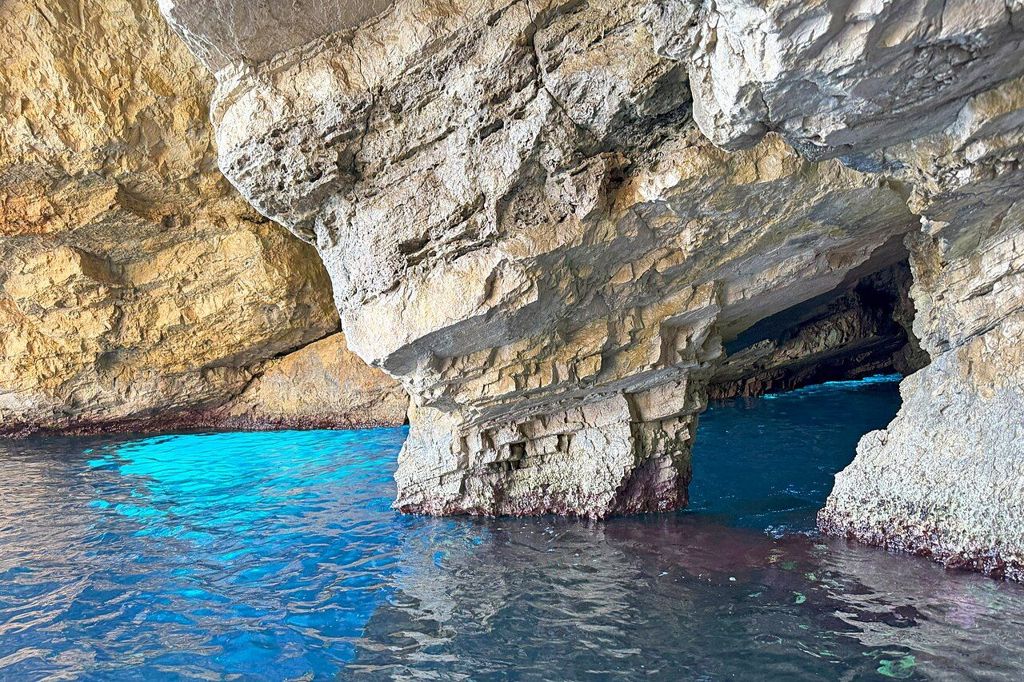
The caves and arches
There is no single Blue Cave. The coast below the cape is a series of hollows, overhangs and arches of different sizes, some large enough for a small boat to pass through and some only for swimmers. The rock is white and cream, streaked orange and red with mineral stains, and worn into honeycomb patterns at the waterline.
Beyond the caves, you can see the mountains of Kefalonia across the strait on a clear day. The water here is deep and very clear; on calm days you can see the bottom many metres down.
Further along: Navagio from the cliff top
Calm-sea timing
The north of Zakynthos is more exposed than the south. In summer a north-westerly wind often rises during the day, building small waves along the cape by the afternoon. When the sea is rough, boats cannot enter the caves safely, and trips may be shortened or cancelled.
- Go in the morning. The sea is usually calmer and the light is better.
- Check the wind forecast the evening before, and ask at the harbour in the morning.
- If a crew decides not to enter a cave, accept it. Swell inside a cave can push a boat against the rock.
- Bring a light layer even in summer; spray on the way out can be cold.
Spring and early autumn often bring settled days, though storms are possible at any time outside high summer.
Boats from the north coast
Small boats to the caves run in season from the small harbour at Agios Nikolaos on the north-east coast, and from a landing below the cape at Skinari reached by steps from the road. Boats from Agios Nikolaos also serve a ferry route to Kefalonia in summer, so the harbour is busy at times; schedules change from year to year, so check before you go. Excursions from other parts of the island, including longer trips that combine the caves with the west coast, are common too.
Trip lengths and stops vary. Most include a pause for swimming near or inside one of the caves. Wear a snorkel mask if you have one; the view down through the blue water is half the experience. Follow the crew's instructions on where it is safe to swim and climb back aboard.
The windmill at the cape
On the headland above the caves stands a white stone windmill with a blue roof and sailcloth arms, one of the best-known landmarks of the north. It sits beside a small lighthouse at the end of the road. The windmill is on private land, so treat it as a view rather than a place to explore, but the paths around the cape give wide views over the sea in both directions.
Windmills like this one once ground grain across the Ionian islands, using the steady winds that blow over exposed headlands. The arms were dressed with cloth sails that the miller could furl or spread to suit the strength of the wind. Today it is a reminder of the island's farming past, set against a sea that now brings most of its visitors.
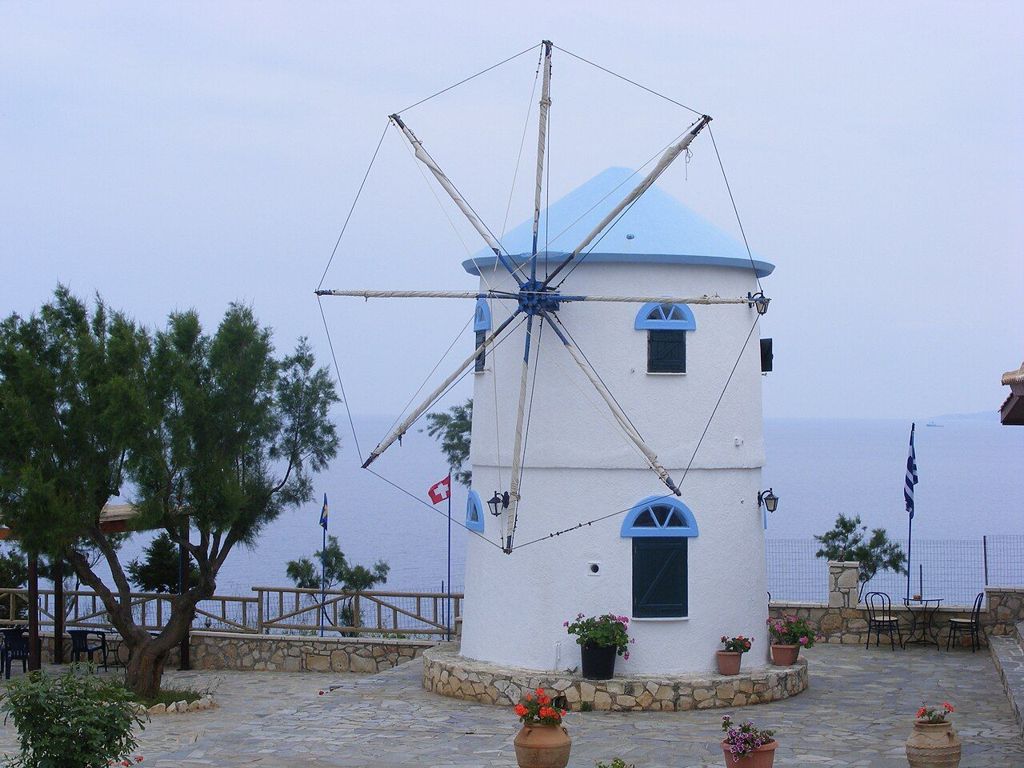
Late in the day the cape is a good place to watch the light change over the strait, even after the caves have lost their colour.
Combining the caves with the north-west
The cape is close to the high plateau of the north-west, with its olive groves and villages such as Volimes. From there, it is a short drive to the cliff-top view of the wreck at Navagio. If you prefer to stay on the water, longer boat trips continue south along the west coast past caves and coves.
For a different kind of sea day, head to the south coast and the turtle waters of Marathonisi and Laganas Bay, where the rules on boat speeds and protected zones are described in full. And if you want more coastal cliffs, the far end of the island has the sea stacks at Keri.